
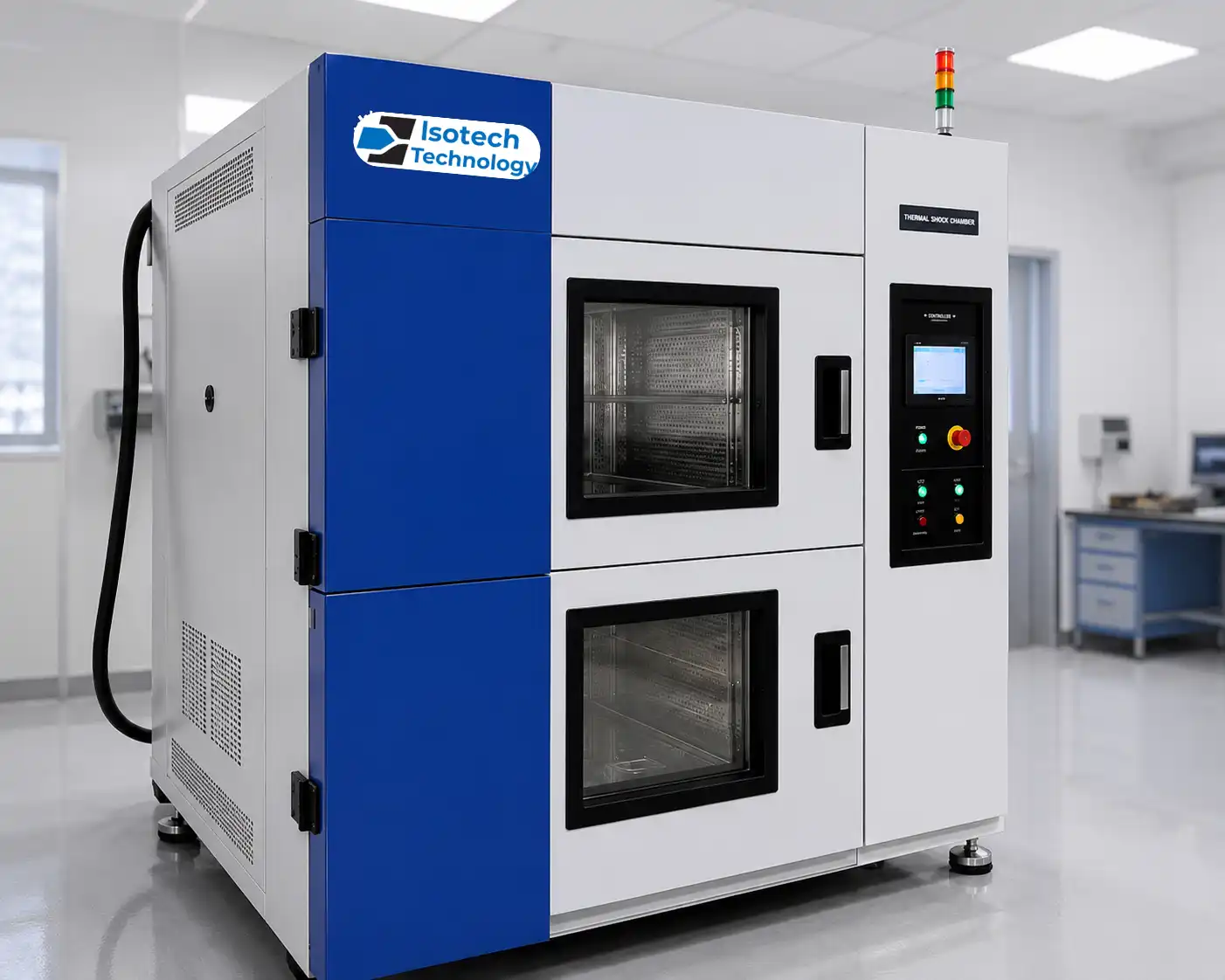
Thermal Shock Chamber vs Hot & Cold Chamber
Before comparing a Thermal Shock Chamber and a Hot & Cold Chamber, it is essential to understand how each chamber operates and the types of tests they are designed to perform. While both are used to assess product reliability under varying temperature conditions, they differ significantly in their working principles, temperature transition techniques, testing procedures, and application requirements.
What is a thermal shock chamber?
A thermal shock chamber exposes a specimen to rapid transitions between a very hot zone and a very cold zone, so that temperature changes almost instantly rather than gradually. ISOTECH’s thermal shock chamber exposes specimens across changing hot and cold test zones to reveal weaknesses that a slow ramp would hide.
There are two common designs:
- Two-zone (basket transfer): the specimen sits in a basket that moves mechanically between a hot chamber and a cold chamber. Transfer is very fast, often within seconds.
- Three-zone (air transfer): the specimen stays still while dampers switch hot and cold air onto it. This suits heavy or delicate loads, since nothing has to move.
A typical thermal shock chamber pairs a hot zone that can reach above 150°C with a cold zone that can go to around −65°C, although exact ranges vary by model. The test is defined by dwell time at each extreme, transfer time and the number of cycles.
Thermal shock testing is used for:
- Solder joints, ICs and PCB assemblies in electronics
- Automotive sensors, ECUs and connectors
- Aerospace and defence components that see rapid altitude and temperature change
- Seals, coatings, glass-to-metal joints and plastics
Common references include IEC 60068-2-14, MIL-STD-883 and MIL-STD-810 temperature shock methods, and JEDEC thermal shock standards. Always check which test method your customer or standard names, because transfer time limits differ.
The purpose of a thermal shock chamber is to cause failure fast, so you find latent defects before your customer does.
What is a hot and cold chamber?
A hot and cold chamber is a single enclosure that heats and cools the specimen along a programmed profile, holding set temperatures for as long as the test needs. ISOTECH’s hot and cold chamber is a temperature-controlled system designed for reliable and practical operation across everyday test requirements.
Heaters raise the temperature and a refrigeration system lowers it, while a fan circulates air for uniformity. The controller sets ramp rate, dwell and cycle count. Typical ramp rates are a few degrees per minute, and faster rates are possible on models fitted for temperature cycling, though still far slower than a thermal shock transfer.
A hot and cold chamber is used for:
Dry heat and cold exposure tests under standards such as IEC 60068-2-1 and IEC 60068-2-2
Temperature cycling and conditioning of electronics, batteries and automotive parts
Storage and operating tests for sub-zero and high-temperature performance
Material ageing, drying and stabilisation before other tests
Its strengths are versatility and uniformity. Because the whole space reaches temperature gradually, you can test larger or heavier specimens, run long dwells and add power to the specimen while it is under test. A hot and cold chamber is also usually less costly to buy and run than a thermal shock system.
If you only need cold, ISOTECH also offers a cold chamber, and for large products there are walk-in hot and cold chambers. For wider needs, see the environmental chamber range.
Thermal shock chamber vs hot and cold chamber: key differences
The core difference in the thermal shock chamber vs hot and cold chamber question is how fast the specimen changes temperature: seconds in one, minutes in the other.
| Factor | Thermal shock chamber | Hot and cold chamber |
| Main purpose | Reveal defects from sudden temperature change | Test performance across a controlled temperature range |
| Temperature change | Seconds, by moving the specimen or switching air | Minutes, along a programmed ramp |
| Design | Separate hot and cold zones (two or three zone) | Single working space |
| Typical ramp | Not applicable, transfer-based | A few degrees per minute |
| Specimen load | Smaller, lighter loads suit basket transfer | Larger and heavier loads possible |
| Powered specimens | Limited, depends on design | Easier to run while under test |
| Common standards | IEC 60068-2-14, MIL-STD-883, MIL-STD-810 | IEC 60068-2-1, IEC 60068-2-2, customer profiles |
| Failure mode found | Cracks, delamination, solder fatigue | Drift, performance loss at temperature extremes |
| Cost | Higher purchase and running cost | Lower purchase and running cost |
| Common users | Electronics, automotive, aerospace, defence | General R&D, QA labs, batteries, materials |
One point causes most confusion: a temperature cycling test with fast ramps is not the same as thermal shock. Some hot and cold chambers can cycle quickly, and that is often enough for conditioning, but if your standard specifies a transfer time, only a thermal shock system can meet it.
Figures in the table are typical values and vary by model, so confirm them against the datasheet.
When to use each
Start from the test method your standard or customer names, not from the machine name.
Choose a thermal shock chamber if:
- Your standard specifies a transfer time or an extreme hot-to-cold change
- You qualify solder joints, ICs, sensors or connectors for harsh field conditions
- You screen aerospace, defence or automotive parts for latent defects
- You want to find failures fast, in fewer cycles than a slow ramp would need
Choose a hot and cold chamber if:
- You test performance at a set hot or cold temperature rather than a sudden change
- Your specimens are large, heavy or need power applied during the test
- You run conditioning, ageing, drying or storage tests
- You test batteries or assemblies where gradual temperature change is the real-world case (see battery testing equipment)
Consider a different chamber if:
- You need humidity control as well, which points to a humidity chamber
- You test large assemblies or full batches, which points to a walk-in environmental chamber
Many labs end up with both. A sensible setup for electronics and automotive labs is a hot and cold chamber for routine qualification and a thermal shock chamber for screening and failure analysis. If budget allows only one, pick the one your most demanding standard requires.
Still unsure? Read ISOTECH’s guide to choosing the right environmental test chamber.
Why the choice matters
The difference between a thermal shock chamber and a hot and cold chamber is speed: a thermal shock chamber moves your product between extreme hot and cold in seconds, while a hot and cold chamber changes temperature gradually along a controlled ramp. Both test how products behave when temperature changes, so buyers often assume one machine can do the job of the other.
In practice, the thermal shock chamber vs hot and cold chamber decision decides whether your test is valid. A slow ramp cannot reproduce the mechanical stress of a sudden change, so solder joints, seals and coatings that would crack in a thermal shock test can pass in a hot and cold chamber. The opposite mistake is just as costly: paying for a thermal shock system when your standard only asks for conditioning or steady-state exposure.
This guide explains how each chamber works, where they differ, which standards and industries call for which, and what to check before you buy. It is written for test engineers, QA managers and procurement teams in Bangalore and across India who want a clear answer before asking for a quote.
What to check before you buy
Whichever chamber you pick, compare these points across suppliers before you place an order.
- Temperature range: confirm both extremes, and for a thermal shock chamber the range of each zone separately.
- Transfer and transition time: for thermal shock, ask for the stated transfer time and whether it meets the method in your standard. For a hot and cold chamber, ask for the ramp rate over the full range, not just a short section.
- Recovery time: after the specimen enters a zone, how long does the air take to return to set point? A long recovery weakens the shock.
- Volume and load capacity: match the working space and the maximum specimen weight, including baskets or fixtures, to your largest sample.
- Controller and data logging: look for programmable profiles, cycle counting, alarms and data export.
- Safety features: over-temperature protection, door interlocks and alarms protect both samples and operators.
- Specimen access: check for cable ports if you need to power or monitor the specimen during the test.
- Customisation: size, shelves, ports and control options should fit your application, not the other way round.
- After-sales support: installation, calibration, preventive maintenance and repair determine how long the chamber stays reliable.
ISOTECH builds configurations around the application and supports the chamber through its life. Read more about services and support, or learn about the company.
Choosing a chamber manufacturer in Bangalore
Buying locally in Bangalore gives you faster service, easier site visits and shorter spare-part lead times. The city is home to aerospace and defence units, electronics and EV developers and research institutes, all of which run thermal shock and temperature tests regularly.
When you shortlist a thermal shock chamber manufacturer in Bangalore or a hot and cold chamber supplier, ask these questions:
- Is the quality system certified, such as ISO 9001:2015?
- Can the team review your test profile and standard before quoting?
- Will they confirm transfer time, ramp rate and recovery time in writing?
- How quickly can service engineers respond, and are spare parts held locally?
- Are calibration and maintenance support available after installation?
- Can they share references from industries similar to yours?
ISOTECH Technology Pvt. Ltd. is an ISO 9001:2015 certified manufacturer based at Peenya Industrial Estate, Bengaluru. It designs and builds environmental test chambers for aerospace, automotive, defence, electronics, pharmaceutical and renewable energy teams, and its clients include ISRO, DRDO, Samsung and IIT Patna. Browse the full list of applications or the complete product range to see how each system fits.
Frequently asked questions
What is the difference between a thermal shock chamber and a hot and cold chamber?
A thermal shock chamber moves the specimen between extreme hot and cold zones in seconds to reveal defects from sudden change. A hot and cold chamber changes temperature gradually along a programmed ramp to test performance across a range. The first suits screening, the second suits qualification and conditioning.
Can a hot and cold chamber be used for thermal shock testing?
Not if your standard sets a transfer time. A hot and cold chamber ramps in minutes, so it cannot reproduce the sudden change of a thermal shock chamber. It can run fast temperature cycling, which is often enough for conditioning but is a different test.
What is the difference between thermal shock and temperature cycling?
Thermal shock changes temperature almost instantly, using separate hot and cold zones. Temperature cycling changes it along a controlled ramp in a single chamber, such as a hot and cold chamber. Always follow the method named in your standard.
Which standards call for thermal shock testing?
Common references include IEC 60068-2-14, MIL-STD-883, MIL-STD-810 and JEDEC thermal shock methods. Requirements for temperature, dwell and transfer time differ, so check the exact method before choosing a chamber.
Which industries use thermal shock chambers?
Electronics, automotive, aerospace and defence teams use them most, to test solder joints, sensors, connectors, seals and coatings. See applications for more.
Can a chamber be customised to my requirement?
Yes. ISOTECH shapes configurations around the application, including size, range and control options. Share your specimen, target temperatures and load with the team to get a recommendation.
Does ISOTECH provide support in Bangalore?
ISOTECH is based in Bengaluru and supports its equipment through installation, calibration, preventive maintenance and repair. See services and support for details.
Get the right chamber for your test
The thermal shock chamber vs hot and cold chamber choice is simple once your test method is clear: pick a thermal shock chamber when sudden temperature change is the test, and a hot and cold chamber when controlled exposure and performance across a range is the test. Check transfer time, ramp rate, recovery and support before you buy, and match each to your standard, whether IEC, MIL-STD or JEDEC.
Share your specimen, target temperatures, load and test method with the ISOTECH engineering team and get a configuration recommendation.
- Request a quote
- Call +91 96064 55074 or email sales@isotechpl.com
- Visit ISOTECH to explore the full range of environmental test chambers